November 20, 2026
Anti-Wrinkle Injections Around the Eyes: Crow's Feet, Brow Position and Safety
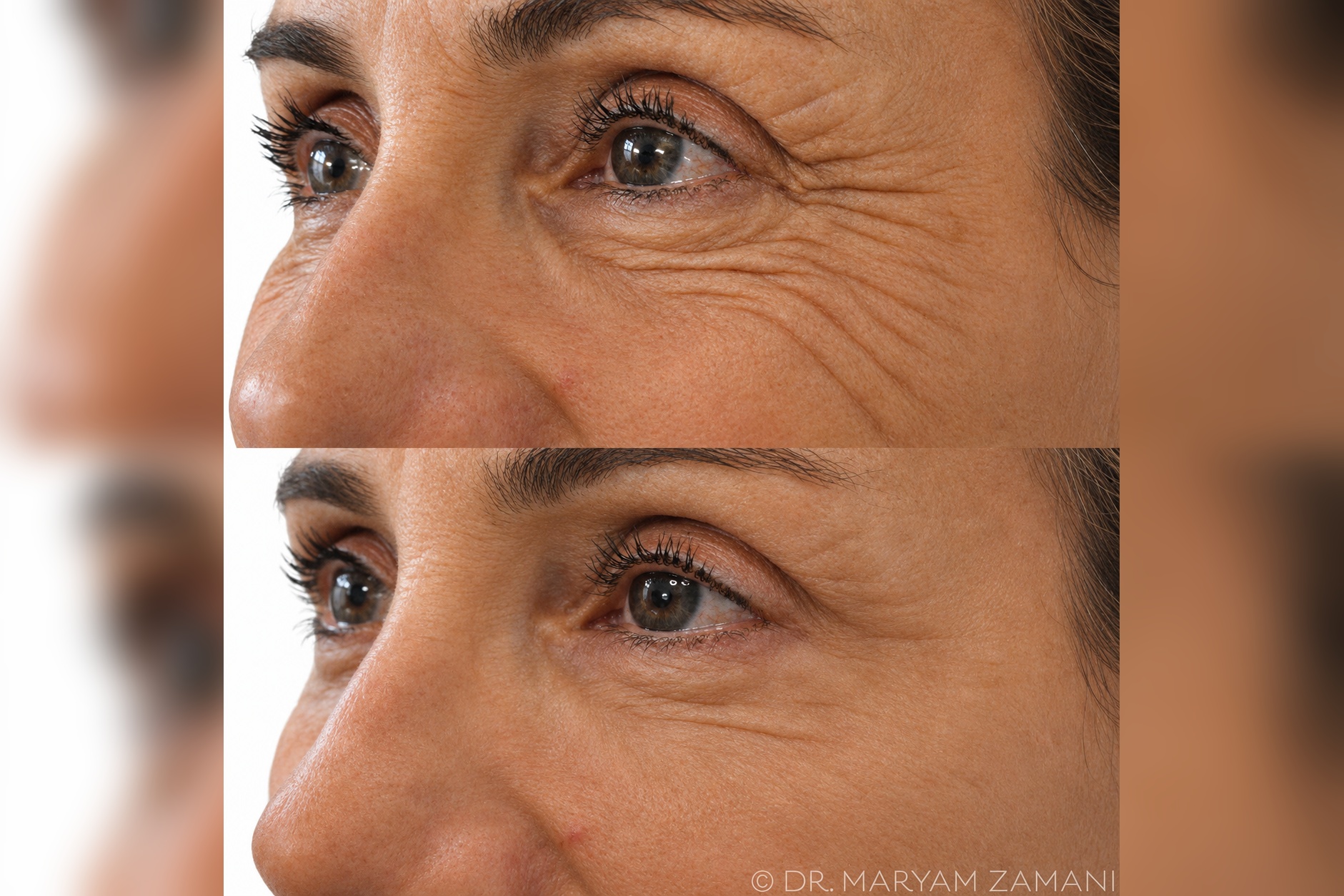
The eyes are where expression shows first. Crow's feet, frown lines between the brows and a brow that has started to sit low are some of the most common reasons people look into anti-wrinkle injections. They are also the areas where the anatomy is least forgiving. The muscles that move the brow, the eyelid and the skin beside the eye sit close together, and a small error in placement can leave a heavy lid or a flat, over-treated look.
That is why who does the treatment matters as much as what is used. Dr Maryam Zamani is an oculoplastic surgeon and facial aesthetics doctor, which means eyelid and brow anatomy is the foundation of her training. At her Chelsea clinic she uses anti-wrinkle injections to soften lines and restore harmony, with a gentle lifting effect where it is appropriate.
In short: anti-wrinkle injections can soften crow's feet and frown lines and subtly shape the brow when they are placed precisely. Results start within days, are usually at their best after about two weeks, and typically last around three to four months. The main risks around the eyes, such as a heavy brow or lid, are reduced by careful assessment and placement.
What can anti-wrinkle injections do around the eyes?
- Crow's feet. The lines that fan out from the outer corners of the eyes when you smile or squint.
- Frown lines. The vertical lines between the brows, often called the elevens.
- Forehead lines. The horizontal lines across the forehead, treated with care to avoid weighing the brows down.
- Brow position. Small, precise adjustments can lift the tail of the brow slightly and open the eye area.
- Overall balance. A good plan treats the muscles as a group, so that one area does not pull against another.
How do anti-wrinkle injections work?
The treatment uses a purified protein, botulinum toxin, injected in tiny amounts into specific muscles. It blocks the signal that makes the muscle contract, so the lines created by that movement soften. It treats lines that are caused by expression. It does not remove lines that are etched into the skin at rest, which need skin treatments such as resurfacing, and it does not replace lost volume.
What should you expect from treatment?
- A consultation first, where your muscles, brow position and eyelids are assessed while you are at rest and in movement
- A short treatment with very fine needles and minimal discomfort
- Results that begin within a few days and settle at around two weeks
- Effects that last around three to four months, after which the muscles gradually return to full movement
- Mild pinkness or a small bruise in some people, which settles quickly
Avoid rubbing the area on the day of treatment and follow the aftercare your clinic gives you. Dr Zamani's article on how to make your results last longer offers practical advice.
What are the risks around the eyes?
Serious problems are uncommon, but the eye area is where they matter most:
- A heavy brow or eyelid. If the treatment affects the muscles that lift the brow or eyelid, the area can look or feel heavy for some weeks.
- Asymmetry. One side may respond differently, and a small top-up is sometimes needed.
- Dry or watery eyes. Rare and temporary, usually when the product has spread more than intended.
- Bruising and headache. Common and short-lived.
These risks come down to anatomy and technique, which is why an oculoplastic surgeon's training is relevant.
Why hooded eyelids and low brows need extra care
Many people with heavy upper eyelids unconsciously raise their forehead muscles to keep the eyes open. If those muscles are relaxed, the brow and eyelids can drop, and the eyes can look and feel heavier. For this reason, anti-wrinkle injections need to be planned differently if you have hooding or a low brow. If this sounds like you, read Dr Zamani's guide to the best treatment for hooded eyelids, and her comparison of upper and lower blepharoplasty. Where the brow has dropped, treatments such as brow ptosis repair, internal brow pexy or the Tri-Brow Lift may be more suitable. If you are planning eyelid surgery, mention it at your consultation so treatments can be timed sensibly.
What can anti-wrinkle injections not do?
They will not treat crepey skin, under-eye hollows, bags or pigmentation. Each of those has a different cause and treatment. Dr Zamani's guides to crepey skin around the eyes, under-eye hollows and a skincare routine for crepey under-eyes explain what does. Injecting directly under the eye is also approached with great caution, because the muscle there supports the lower lid and the smile.
How do you choose a practitioner in the UK?
Botulinum toxin is a prescription-only medicine. In the UK it should only be supplied after an assessment by a qualified prescriber. Practical points to check:
- The person prescribing and treating is a registered healthcare professional, such as a doctor, dentist, prescribing nurse or pharmacist
- You have a proper consultation before treatment, not just on the day
- The clinic explains the risks, aftercare and what happens if you are not happy
- They are comfortable saying no when treatment is not the right option
- They have specific experience of the eye and brow area
When should you start, and how often?
There is no set age. It depends on how much your expressions are etching lines into the skin and how you feel about them. Treatment is usually repeated every three to four months, and some people stretch the gap as lines soften. Dr Zamani's article on the pros and cons of starting in your twenties gives her view. For a wider perspective, see this feature on anti-wrinkle injections beyond wrinkles.
Book a consultation with Dr Maryam Zamani
If you would like to soften lines around your eyes, the first step is a consultation that looks at your muscles, brow and eyelids together. Book a consultation at Dr Maryam Zamani's Chelsea clinic and she will recommend what, if anything, is right for you. You can also read more about Dr Zamani and view current pricing.
Testimonials
Trustindex rating score: 4.7 of 5, based on 222 reviews
JT

My recent experience with the lovely Dr Maryam Zamani and her fabulous team was outstanding. Dr Maryam gave very professional and proactive...
EC
Maryam is highly skilled when it comes to injecting Botox and filler in the right places, and in the right amount. With other practitioners and doctors I have...
JB
The only one I trust for my skin since 10 years. She is truly amazing and an example for women . Very very happy about my laser treatment and her team is...
MCL
After taking my time researching plastic surgeons I decided to go to Dr. Zamani. I watched her IG often, saw what type of treatments she...
SS
I have been a patient of Dr Zamani’s for years, and to put it lightly, I will never let anyone touch my face if it isn’t her! Not only is Dr Zamani a wonderful person, her....
NC
I visited Doctor Zamani with very droopy upper eyelids and I had been thinking about surgery for sometime. I was given Doctor Zamani’s name by a friend who is in...
Frequently asked questions
How long do anti-wrinkle injections last around the eyes?
Results typically last around three to four months. The effect gradually fades as the muscle regains movement. Some people find that regular treatment makes the effect last a little longer.
How soon will I see results?
Most people notice changes within three to seven days, with the full effect at around two weeks. A small top-up is sometimes offered at a review if needed.
How soon will I see results?
It is uncommon, but it can happen if the treatment affects the muscles that lift the eyelid or brow. Careful assessment and placement reduce the risk, and any effect is temporary.
Can anti-wrinkle injections fix hooded eyes?
They can sometimes help mild hooding that is caused by the brow sitting low, by lifting the tail of the brow slightly. They cannot remove excess eyelid skin, so significant hooding needs a different approach.
Does it hurt?
Most people find it a quick, mild sensation, like tiny pinpricks. The area around the eyes is sensitive, and fine needles keep discomfort low.
What is the best treatment for crow's feet?
Anti-wrinkle injections are the most effective treatment for the lines caused by movement. Lines that remain at rest can be improved with skin treatments such as laser resurfacing or skin boosters.
Frequently asked questions
How long do anti-wrinkle injections last around the eyes?
Results typically last around three to four months. The effect gradually fades as the muscle regains movement. Some people find that regular treatment makes the effect last a little longer.
How soon will I see results?
Most people notice changes within three to seven days, with the full effect at around two weeks. A small top-up is sometimes offered at a review if needed.
Can anti-wrinkle injections cause droopy eyelids?
It is uncommon, but it can happen if the treatment affects the muscles that lift the eyelid or brow. Careful assessment and placement reduce the risk, and any effect is temporary.
Can anti-wrinkle injections fix hooded eyes?
They can sometimes help mild hooding that is caused by the brow sitting low, by lifting the tail of the brow slightly. They cannot remove excess eyelid skin, so significant hooding needs a different approach.
Does it hurt?
Most people find it a quick, mild sensation, like tiny pinpricks. The area around the eyes is sensitive, and fine needles keep discomfort low.
What is the best treatment for crow's feet?
Anti-wrinkle injections are the most effective treatment for the lines caused by movement. Lines that remain at rest can be improved with skin treatments such as laser resurfacing or skin boosters.
Is it safe to have anti-wrinkle injections near the eyes?
When carried out by a trained prescriber with detailed knowledge of the anatomy, it is considered safe and is widely performed. Choosing an experienced practitioner and following aftercare advice makes the biggest difference.
Book Consultation
As a leading Oculoplastic Surgeon with special interest in Facial Aesthetics, Dr. Maryam Zamani has garnered a global reputation - both in the US and UK - for her meticulous attention to detail and sought-after techniques for eyes and facial aesthetics.
Thank you! Your submission has been received!
Oops! Something went wrong while submitting the form.
Find The Clinic by Dr Maryam Zamani in the heart of Chelsea
Book an eyelid surgery consultationLocated on the Kings Road, our clinic is easy to reach from Chelsea, Kensington, Belgravia, Knightsbridge, South Kensington, Fulham and Battersea. We are positioned just moments from Sloane Square with excellent transport links across Central and South West London.
Public Transport
- Nearest tube: Sloane Square (District & Circle lines)
- Approx. 5-minute walk
- Multiple bus routes along King’s Road
Parking
- Metered on-street parking available on surrounding roads
- Nearby car parks: Duke of York Square & Cadogan Place
- Please allow additional time during peak hours
Accessibility: Please let us know if you require any assistance prior to your appointment, our team will be happy to help ensure your visit is comfortable.