November 20, 2026
Best Treatment for Acne Scars: What Works for Each Scar Type
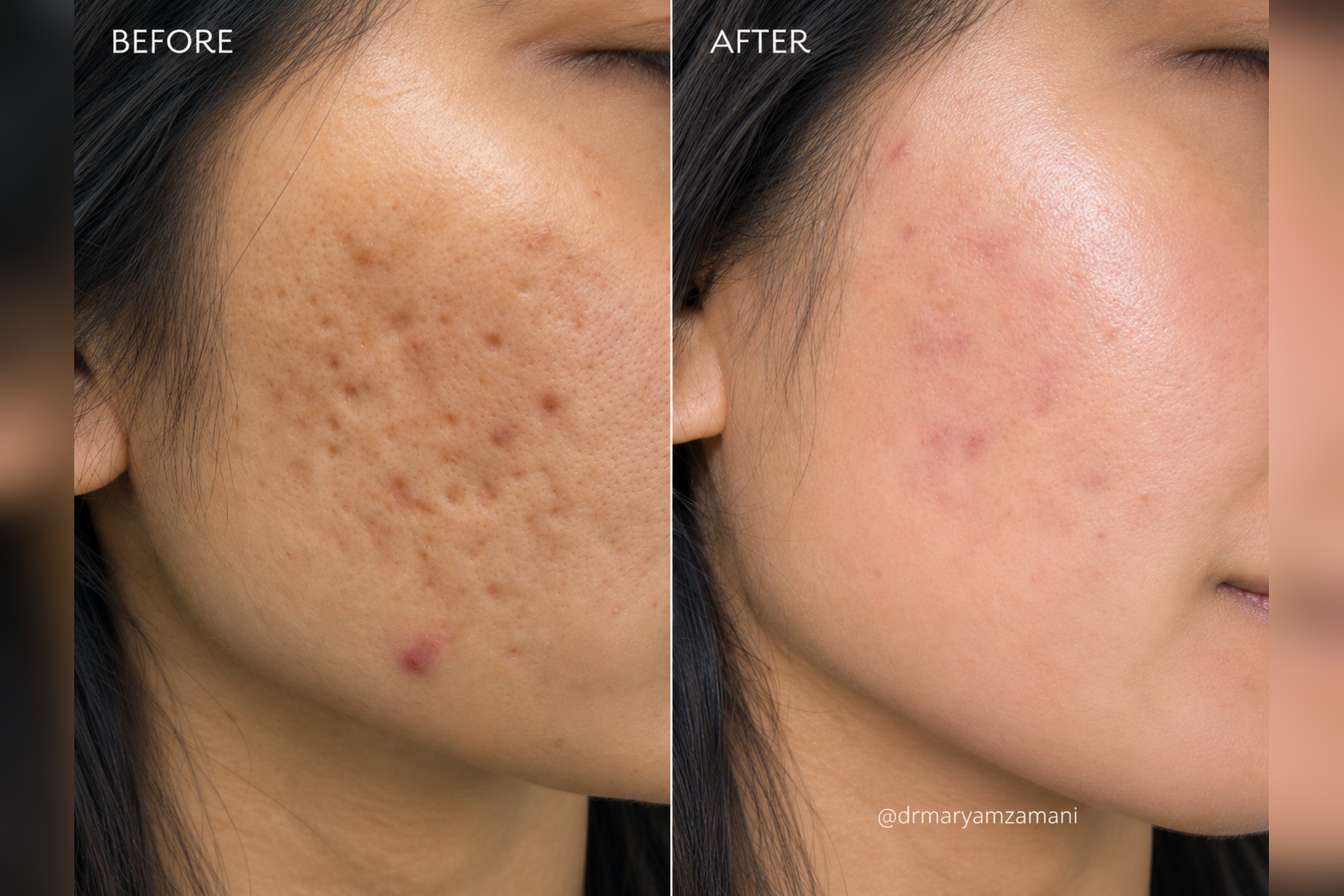
Acne has usually gone long before people start looking into acne scars. What remains is a surface that catches the light differently, pits that make-up settles into, or marks that refuse to fade. It is easy to assume there is one treatment for all of it. There is not, and that is why so many people try a product or a procedure and see little change.
Acne scars come in different forms, and each responds to a different approach. A treatment that smooths shallow, rolling scars may do little for narrow, deep pits, and neither will help a red or brown mark that is not a true scar at all. Dr Maryam Zamani, an oculoplastic surgeon and facial aesthetics doctor, begins every scar consultation by identifying exactly what is there, and she offers the full range of treatments at her Chelsea clinic.
In short: match the treatment to the scar. Shallow and rolling scars often improve with microneedling or radiofrequency treatment. Deeper pitted scars usually need laser resurfacing. Red and brown marks fade with light, peels and sun protection. Raised scars are a different problem and need a different plan. Improvement is gradual and usually needs a course of treatment over several months.
What are acne scars?
Acne scars form when inflammation damages the collagen beneath the skin. Some people lose collagen and are left with depressions. Others produce too much and develop raised scars. Many people also have marks that look like scars but are only pigment or redness left behind by a spot.
If you are still getting breakouts, the first step is to control the acne. Dr Zamani's acne scarring page explains how the clinic approaches it.
What types of acne scar are there?
Most people have a mix. Treatment plans usually combine two or three approaches.
Should you treat active acne first?
Yes. New scars keep forming while breakouts continue, and treating scars in the middle of a flare is less effective. For persistent acne, the clinic offers AviClear, a laser treatment designed for all severities of acne, and Acne Clear BBL. Not picking spots makes a real difference to how many scars you are left with.
What are the best treatments for acne scars?
Microneedling and AquaGold
Microneedling creates tiny channels in the skin that trigger collagen renewal, and it suits shallow to moderate scars and rolling scars. AquaGold Fine Touch is a microneedling system that delivers a tailored cocktail of ingredients as it works. Both are usually done as a course.
Radiofrequency microneedling
Morpheus8 combines microneedling with radiofrequency energy to remodel collagen at a greater depth. It can suit broader scars and skin laxity. Dr Zamani explains how it differs from standard microneedling in her guide to RF microneedling vs microneedling.
Fractional and ablative lasers
For deeper pitted scars, laser resurfacing is usually the most effective option. HALO is a hybrid fractional laser, ProFractional is an ablative erbium laser, Contour TRL is a tuneable erbium laser, and CO2 laser offers both ablative and non-ablative resurfacing. Deeper settings mean more downtime and stronger results. MOXI is a gentler non-ablative option.
Darker skin tones need particular care with laser settings, because inflammation can leave pigment behind. This is a reason to choose a doctor-led clinic.
Gentle light-based treatment
Laser Genesis is a non-invasive laser that boosts collagen and elastin and can improve acne scars, pores and uneven texture, with little downtime. It suits milder scarring and can help red marks.
Peels for marks and texture
The Skin Renewal Peel, VI Peel Precision Plus and Dermamelan are used for pigmentation, including marks left after acne. They fade colour, but they do not lift depressed scars.
Skin boosters, polynucleotides and PRP
These treatments improve skin quality and texture. Skin boosters, polynucleotides and PRP are often combined with microneedling or laser. Dr Zamani's article on skin boosters for acne scarring goes into more detail.
Filler for individual depressions
For some distinct, broad depressions, hyaluronic acid filler can lift the scar temporarily to bring it level with the skin. It suits a small number of scars and is usually combined with other treatment.
Why combination plans work best
Scars are rarely one type, and each treatment targets a different layer. A common plan might resurface the deeper scars, use microneedling or radiofrequency to improve overall texture, and add a peel or light treatment for marks. Sequencing and spacing matter, which is why a doctor-led plan tends to outperform a series of unrelated sessions.
How many treatments will you need, and what is realistic?
Most scar treatments are done as a course, and collagen continues to rebuild for several months after each session, so results are judged over time. Scars improve by degrees. Complete removal is not a realistic promise, and anyone who offers it should be treated with caution. A good plan will tell you honestly how much improvement is likely for your type of scar.
Can you get rid of acne scars naturally in a week?
No. Home care can fade red and brown marks over time with daily SPF and sensible skincare, but depressed scars need treatment that rebuilds collagen. Products that claim to remove scars in days cannot deliver that. Sun protection is the most useful thing you can do at home, because UV makes marks darker and slower to fade.
How do you choose a clinic for acne scar treatment in London?
- Look for a doctor-led clinic that identifies your scar types before recommending anything
- Ask which treatments are suited to your skin tone and why
- Expect a plan with several treatments, not a single device
- Ask about downtime for each option, so you can plan around it
- Be wary of guarantees
The team at The Clinic includes Consultant Dermatologist Dr Amelie Seghers alongside Dr Zamani.
Book a consultation with Dr Maryam Zamani
If acne scars are bothering you, the first step is an assessment that identifies exactly which types you have. Book a consultation at Dr Maryam Zamani's Chelsea clinic and she will recommend a plan suited to your skin. You can also read more about Dr Zamani, explore her scar management service and view current pricing.
Testimonials
Trustindex rating score: 4.7 of 5, based on 222 reviews
JT

My recent experience with the lovely Dr Maryam Zamani and her fabulous team was outstanding. Dr Maryam gave very professional and proactive...
EC
Maryam is highly skilled when it comes to injecting Botox and filler in the right places, and in the right amount. With other practitioners and doctors I have...
JB
The only one I trust for my skin since 10 years. She is truly amazing and an example for women . Very very happy about my laser treatment and her team is...
MCL
After taking my time researching plastic surgeons I decided to go to Dr. Zamani. I watched her IG often, saw what type of treatments she...
SS
I have been a patient of Dr Zamani’s for years, and to put it lightly, I will never let anyone touch my face if it isn’t her! Not only is Dr Zamani a wonderful person, her....
NC
I visited Doctor Zamani with very droopy upper eyelids and I had been thinking about surgery for sometime. I was given Doctor Zamani’s name by a friend who is in...
Frequently asked questions
What is the best treatment for acne scars?
The best treatment depends on the type of scar. Shallow and rolling scars often respond to microneedling or radiofrequency. Deeper pitted scars usually need laser resurfacing. Red and brown marks respond to light and peels. Most plans combine more than one approach.
Can acne scars be removed completely?
Most acne scars can be improved, sometimes significantly, but complete removal is rarely realistic. A doctor can explain how much improvement to expect for your scars.
Can acne scars be removed completely?
Fractional and ablative lasers, such as HALO, ProFractional, Contour TRL and CO2, are usually the most effective for pitted scars. Gentler lasers suit milder scarring. The right choice depends on your scar depth and skin tone.
Is microneedling good for acne scars?
Yes, particularly for shallow, moderate and rolling scars. It stimulates collagen and improves texture over a course of treatments. Deeper pitted scars usually need laser resurfacing as well.
How many sessions do I need?
Most people need a course of several sessions, spaced weeks apart, with results continuing to build for months afterwards. Your doctor will give you a plan based on your scars.
Do acne scars get better with age?
Usually not on their own. As collagen declines with age, depressed scars can become more noticeable, which is one reason many people choose to treat them.
Frequently asked questions
What is the best treatment for acne scars?
The best treatment depends on the type of scar. Shallow and rolling scars often respond to microneedling or radiofrequency. Deeper pitted scars usually need laser resurfacing. Red and brown marks respond to light and peels. Most plans combine more than one approach.
Can acne scars be removed completely?
Most acne scars can be improved, sometimes significantly, but complete removal is rarely realistic. A doctor can explain how much improvement to expect for your scars.
Which laser is best for acne scars?
Fractional and ablative lasers, such as HALO, ProFractional, Contour TRL and CO2, are usually the most effective for pitted scars. Gentler lasers suit milder scarring. The right choice depends on your scar depth and skin tone.
Is microneedling good for acne scars?
Yes, particularly for shallow, moderate and rolling scars. It stimulates collagen and improves texture over a course of treatments. Deeper pitted scars usually need laser resurfacing as well.
How many sessions do I need?
Most people need a course of several sessions, spaced weeks apart, with results continuing to build for months afterwards. Your doctor will give you a plan based on your scars.
Do acne scars get better with age?
Usually not on their own. As collagen declines with age, depressed scars can become more noticeable, which is one reason many people choose to treat them.
What is the difference between acne scars and acne marks?
Scars involve a change in the skin's structure, such as a pit or a raised area. Marks are flat red or brown discolouration left by inflammation. Marks often fade with time and sun protection, while scars need treatment.
Book Consultation
As a leading Oculoplastic Surgeon with special interest in Facial Aesthetics, Dr. Maryam Zamani has garnered a global reputation - both in the US and UK - for her meticulous attention to detail and sought-after techniques for eyes and facial aesthetics.
Thank you! Your submission has been received!
Oops! Something went wrong while submitting the form.
Find The Clinic by Dr Maryam Zamani in the heart of Chelsea
Book an eyelid surgery consultationLocated on the Kings Road, our clinic is easy to reach from Chelsea, Kensington, Belgravia, Knightsbridge, South Kensington, Fulham and Battersea. We are positioned just moments from Sloane Square with excellent transport links across Central and South West London.
Public Transport
- Nearest tube: Sloane Square (District & Circle lines)
- Approx. 5-minute walk
- Multiple bus routes along King’s Road
Parking
- Metered on-street parking available on surrounding roads
- Nearby car parks: Duke of York Square & Cadogan Place
- Please allow additional time during peak hours
Accessibility: Please let us know if you require any assistance prior to your appointment, our team will be happy to help ensure your visit is comfortable.